


The Republic’s Crucible: A Constitutional Moment
- Rich Washburn

- Aug 4, 2025
- 5 min read
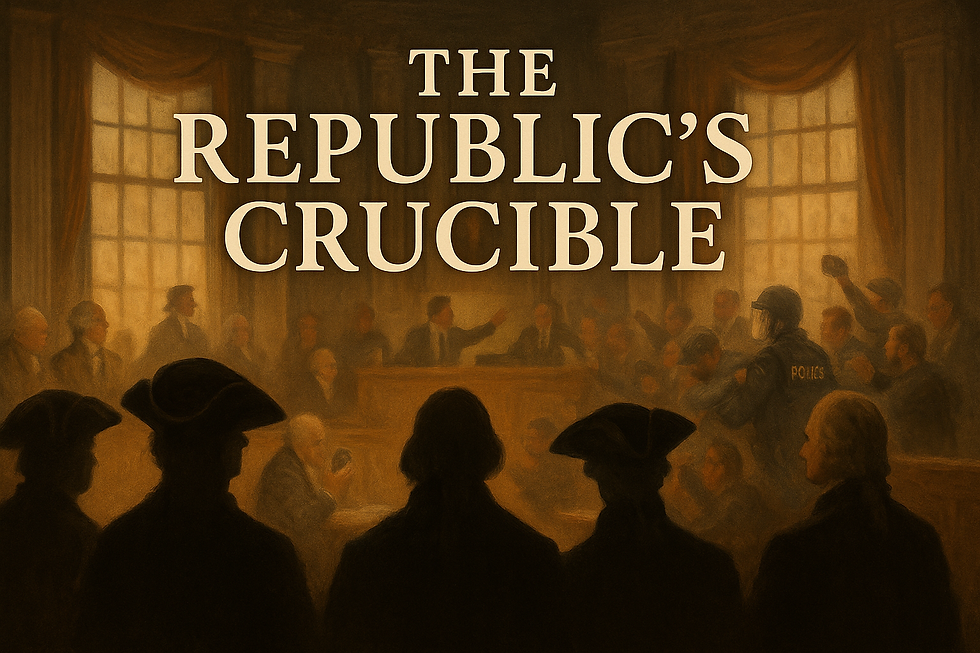
History rarely reveals its full truths in the moment. Only with the clear eye of hindsight and the long view of time do we grasp the true weight of events as they unfold. Across the centuries and millennia, the rise and fall of civilizations has often hinged on narrow margins—moments when the course of history almost bent, but was held fast by the strength or frailty of human will.
Consider the great empires of antiquity: Rome, Athens, Byzantium. They flourished, shining examples of governance, culture, and power, but each succumbed in the end to internal decay, factionalism, and the corrosion of civic virtue. The fall of Rome was not merely a consequence of barbarian invasions, but the slow erosion of its republican spirit, its commitment to law and shared sacrifice. Greece’s city-states, masters of democracy and philosophy, fell victim to division and strife, proving that freedom without unity is a fragile thing.
Jumping forward, history delivers a pattern as stark as it is sobering: republics and democracies are fragile, requiring constant care and vigilance. The American Republic was born amid this awareness, the Founders crafting a unique experiment not to defy history’s lessons, but to learn from them—anticipating the dangers of faction, corruption, and tyranny.
The Cold War Mirror: A Modern Near-Miss
Fast forward to the 20th century. We stand on the precipice of nuclear annihilation during the Cold War, a standoff so tense that it was later revealed the world narrowly escaped multiple times from instant destruction—by miscalculation, human error, or sheer luck. We do not yet know the full extent of how many close calls were veiled in secrecy. But these near-catastrophes remind us that even the most advanced and powerful nations can almost unravel with a single misstep.
Our Republic, however, faced a different kind of existential threat in recent years—less visible, perhaps, but no less dangerous. Not a threat from foreign armies or missiles, but from within: a conspiracy to subvert the will of the people, undermine the peaceful transfer of power, and dismantle the constitutional order.
The Flame of Liberty
This moment we face is nothing short of a crucible—a test of whether the Republic, now nearly 250 years old, will endure or falter. The flame of liberty, once bright and fierce, now flickers in the storm of division and deceit. It is a flame kindled by sacrifice—the blood and toil of generations who risked everything for freedom—and it must not be allowed to go out.
We are witnesses to an unfolding constitutional crisis. While many may see it through the prism of partisan conflict, the deeper truth cuts through all politics: this is a battle for the soul of the Republic itself.
The Constitution as Our Guide
The Founders did not construct the Constitution as a fragile relic to be admired from a distance. They fashioned it as a living, breathing safeguard—an enduring Rosetta Stone for understanding and navigating crises that would arise long after their time.
They studied the failures of history’s republics and crafted a system to guard against the very threats we face today: ambition unchecked, factions breaking the Union, conspiracies to overturn the law. The genius of their design lies not only in its structure but in its call for active citizenship, for the moral courage to defend liberty against all enemies, foreign and domestic.
The Road Ahead: An Invitation to Vigilance and Action
Our task is clear: to awaken the spirit of liberty and justice, to reclaim the constitutional order from the brink of collapse. This is no mere exercise in nostalgia for a bygone era, but a call to arms for every citizen who cherishes freedom.
The years ahead will reveal just how close we came to losing the Republic. Like the secret nuclear near-misses of the Cold War, this moment’s full danger is yet to be fully revealed. But the lesson is undeniable: republics are not self-sustaining. They demand eternal vigilance, courage, and above all, a dedication to the principles enshrined in the Constitution.
When Law is Betrayed
Our Republic’s current crisis is unlike any mere political dispute. It is a direct assault on the constitutional framework—the very heart of our system of government. The peaceful transfer of power, a cornerstone of the American experiment, was challenged with unprecedented ferocity. Efforts to undermine election results, spread falsehoods, and erode public trust struck at the core of the social contract.
This is no ordinary political rift. It is a betrayal of the Constitution, a conspiracy to subvert the rule of law itself.
Is This Treason? Understanding the Gravity of the Crimes
The Founders understood that threats from within could be the most dangerous. That is why Article III, Section 3 of the Constitution defines treason in narrow but clear terms: levying war against the United States, or adhering to their enemies, giving them aid and comfort.
While we must be precise and deliberate in applying such weighty charges, the recent attempts to overturn lawful elections, to incite insurrection, and to erode the constitutional order demand rigorous judicial examination. The question before us: do these acts meet the high bar of treason, or do they constitute other serious federal crimes—sedition, conspiracy, obstruction of justice—that require accountability?
The framers were clear—no one is above the law, not even the highest officials. They designed mechanisms for impeachment, trial, and removal from office precisely to safeguard the Republic from internal threats.
James Madison warned that “the means of defense against foreign danger have been always the instruments of tyranny at home.” Hence, the Constitution balances power with accountability—an eternal check against the rise of despots.
A Nation at the Crossroads
The legal processes now unfolding are not mere formalities; they are the Republic’s firewall. Our judicial institutions must act decisively to uphold the Constitution, deter future assaults, and restore public faith.
But legal action alone is insufficient. The American people must rise to their role as stewards of liberty. Civic education, political engagement, and a recommitment to constitutional principles are vital.
Enduring Wisdom of the Founders
The Republic stands not merely on laws and institutions, but on the virtue of its citizens. The Founders sacrificed much to establish a government “of the people, by the people, for the people.” They foresaw the temptations of power and the corrosive effects of factionalism.
Yet they also believed in the resilience of a free people, united by shared values and an unyielding commitment to justice.
A Future Forged in Liberty
As we approach the Republic’s 250th anniversary, we find ourselves at a moment of great peril—but also great opportunity. The past warns us, but it also instructs us.
Our founders did not create a perfect nation; they created a perfect framework for freedom—one that demands constant vigilance and renewal.
The question is not whether we face darkness, but how brightly we will shine our light in response. The legacy of our Republic depends on the answer.
The Republic’s crucible is upon us. The Constitution is our guide through this historic moment. It demands that we rise to the occasion, defend the rule of law, and renew our faith in the promise of America.
At the 917 Society, we believe that understanding and defending our Constitution is the greatest act of patriotism. Join us in standing firm for the Republic, honoring the sacrifices of our Founders, and ensuring that liberty and justice endure for generations to come. Get involved today—our nation’s future depends on it.


Comments