


America 250 Civics Education: Why the Document Is Still Being Used

More than one hundred ballot measures were decided across the country this week, and a remarkable share of them were about constitutions. It is the clearest America 250 civics education lesson we are likely to get this year, and it did not happen in a classroom. Voters in Nevada, North Carolina, and Ohio wrote voter ID into their state constitutions. Arkansas, Kansas, South Dakota, and West Virginia amended theirs to state plainly that only citizens may vote. Missourians voted 62 to 38 to reject a congressional map their legislature had drawn, and then went further, making it harder for lawmakers to undo voter-approved amendments without a supermajority. Virginians restored voting rights to citizens who have finished their sentences. Coloradans put a school ballot measure question to themselves in plain language, some of it written at an eighth-grade reading level.
Whatever you think of any one of those results, the pattern is the point. America 250 civics education is not an abstraction we are commemorating this year. It is happening in the voting booth, one amendment at a time, and it has been happening since 1787.
The founders did not hand us a finished monument. They handed us a process. Article V exists precisely because they expected the document to be amended by the people it governs, and the states have ratified 27 amendments since. This week, several states used that machinery on a single Tuesday. That is the American system working exactly as designed.
Which is why the classroom matters so much in this anniversary year.
An eighth grader who has never held the Constitution in their hands cannot be expected to make sense of an amendment on a ballot five years from now. But a thirteen-year-old who has read the Preamble, who knows what the Bill of Rights actually protects, and who can find Article V in a printed copy is a citizen in training. They will meet their first ballot measure with something better than a television ad.
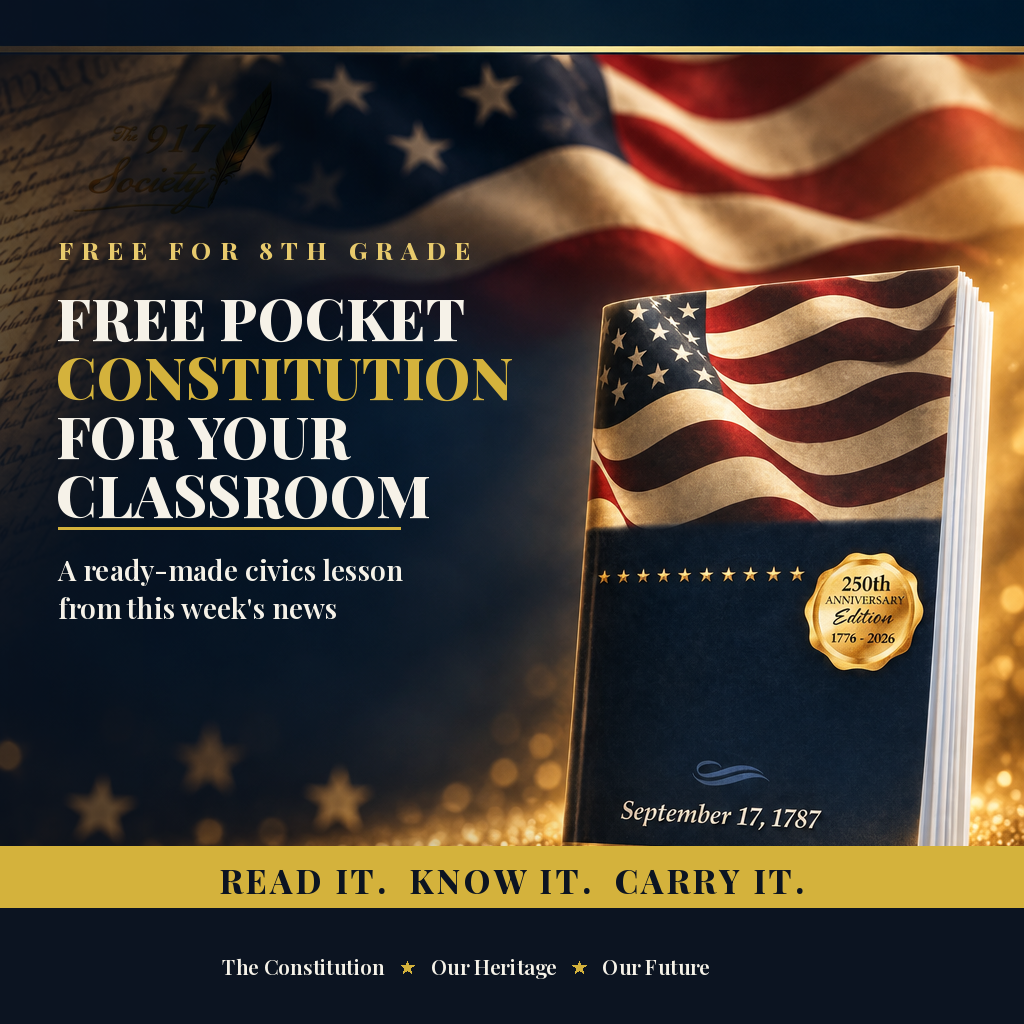
That is the whole purpose of the 917 Society, and it has been since we started. Every year we put pocket Constitutions into the hands of 8th graders, free of charge, in every state that asks for them. It is the 250th anniversary edition of Celebrating the Constitution and U.S. Citizenship, the full text paired with the story of how American citizenship took shape, sized to fit a back pocket.
America 250 civics education started with a document, not a celebration
The semiquincentennial has produced its share of fireworks, time capsules, and block parties, and there is nothing wrong with any of that. But the anniversary is at its most useful when it puts the actual text back into circulation. A student who can quote the First Amendment is harder to mislead than one who has only seen a flag on a poster.
This week gave us a rare teaching moment. Across the country, ordinary people looked at proposed changes to the fundamental law of their states and voted them up or down. Some of those decisions expanded rights. Some restricted them. Some rejected the premise of the question entirely. In every case, the people doing the deciding needed to understand what a constitution is for.
That understanding is built years earlier, in a civics classroom, with a book in hand.
What you can do in this anniversary year
If you are a teacher, request free Constitutions for your 8th graders. There is no cost to your school and no catch. We ship them, you hand them out, and a student keeps one.
If you are a supporter, buying a copy for yourself, for a family member, or for someone who loves this country funds the free copies going into classrooms. That is how the whole thing works. Learn more at 917society.org →
And if this week made you think about the document in a new way, read it again. It is short. It is not easy, but it is short. The whole architecture of the argument is right there, and it belongs to you.
Why America 250 civics education has to reach the classroom
July 4, 2026 has come and gone. The confetti has been swept up. What remains is the question the anniversary was always meant to force: now that we have celebrated it, do we know it?
A generation of 8th graders is in civics class right now. They will vote for the first time in the 2030s, and they will decide questions we cannot yet imagine. Whether they recognize the Constitution as theirs, or as a relic they were tested on once, depends on what reaches their hands this year.
That is the work. It is quiet, it happens in classrooms, and it is the most patriotic thing we do.


Comments